In this first installment of a new blog series, we begin to explore from a comprehensive perspective a fundamental yet often overlooked issue in modern science: The Economic Cost of Research Integrity. Throughout this series, we will break down step by step the hidden impacts, the invisible investments, and the financial consequences that researchers, institutions, and publishers face when trust in the scientific system fails.
With the growing number of manuscripts submitted to scholarly journals, and now with AI becoming part of the way research is conducted, written, and published, I have been thinking about something that receives relatively little attention when we discuss research integrity, and that is how much it actually costs when things go wrong.
We hear a great deal about research misconduct, questionable publishing practices, manipulated data, and the increasing difficulties editors and publishers face in identifying problematic manuscripts, but we rarely stop to consider how much money, time, and professional effort have already gone into a piece of research by the time someone discovers that its findings cannot be trusted.
We also tend to discuss the cost of maintaining research integrity systems as an additional expense for universities and publishers, without necessarily considering what the alternative might cost them.
One of the difficulties in trying to understand these costs is that research integrity does not depend on one person, one organization, or even one stage of the research and publishing process.
A researcher may spend several years working on a project funded by a university or a research grant, using laboratories, equipment, research assistants, and institutional resources, before the findings are submitted to a journal where editors, reviewers, and publishing staff invest additional time in evaluating and preparing the manuscript for publication.
Each of these activities has a cost, although we do not always see it because the money comes from different budgets and the people involved are often employed by different organizations.
A peer reviewer, for example, may not receive any payment from the journal, but the hours spent reviewing a manuscript are still part of their professional time, which is usually supported by the university or research institution where they work. When we add all these contributions together, we begin to see that producing and publishing a scientific article involves a much larger investment than the publication costs that are most immediately visible.
Now consider what happens when a manuscript contains fabricated data, manipulated images, or deliberately misleading findings, and these problems are not identified until after publication. By that point, the research may have consumed years of funding and staff time, the journal may have spent months managing the submission and peer review process, and the publisher may have invested additional resources in producing and distributing the article.
If the problems are discovered later, more people become involved in investigating what happened, communicating with the authors and their institutions, reviewing the evidence, and deciding whether a correction or retraction is necessary. Some of these costs could potentially have been avoided if the problems had been identified earlier, although we should be careful not to assume that every retraction represents misconduct or that every error could reasonably have been prevented.
Scientific research involves uncertainty, researchers sometimes make honest mistakes, and the willingness to identify and correct those mistakes is an important part of maintaining confidence in the scientific record. What concerns me more are the cases where serious problems remain undetected as a manuscript moves through the system, with each stage adding further investment to work whose reliability is already compromised.
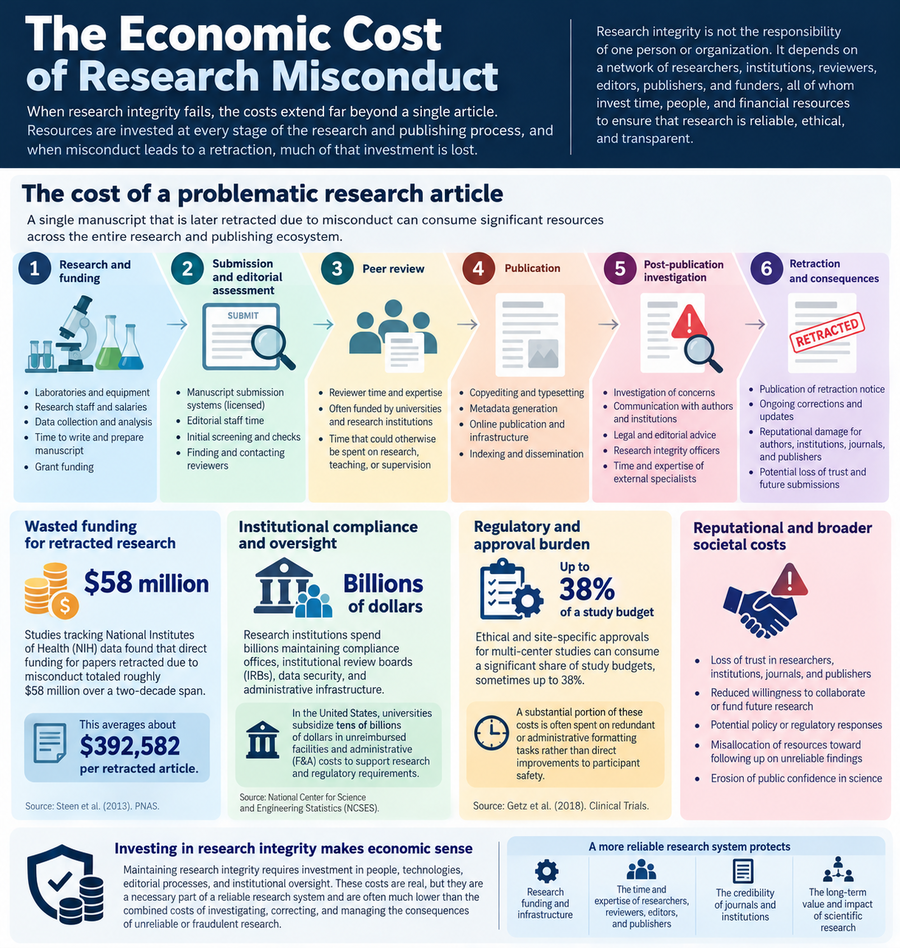
Following the cost of a problematic research article
To understand how much research misconduct can actually cost, I think it is useful to follow what happens to a research project from the time it receives funding until its findings are published.
By the time a researcher submits a manuscript to a journal, the institution or funding organization supporting the work may have already invested considerable resources in laboratory facilities, equipment, research materials, salaries, data collection, and analysis, not to mention the months or sometimes years that researchers have spent conducting the study and preparing the results for publication.
We rarely think about all these expenses when we read a scientific article, but they are part of the investment that makes the research possible in the first place, and the expectation is that the findings will eventually contribute something useful to the scientific community.
But what happens if the manuscript contains fabricated data or deliberately manipulated findings, and nobody identifies the problem before it is submitted? At this point, the research funding has already been spent, but the manuscript is about to enter another process that involves a different set of people, organizations, and expenses.
The journal has to maintain a submission system, employ or support editorial staff, and manage the communication between authors, editors, and reviewers, while the editor handling the manuscript spends time reading it, checking whether it is suitable for the journal, and finding researchers who are willing and qualified to review it.
All of this takes time, and although editorial screening can identify some problems before peer review begins, it would be unrealistic to expect editors to detect every instance of data fabrication, image manipulation, or other questionable research practices at this stage.
If the manuscript passes the initial checks, it moves to peer review, which introduces another cost that I think is often overlooked because most reviewers are not paid directly for their work.
A researcher who spends several hours, or sometimes several days, reviewing a manuscript is using time that could have been spent conducting research, supervising students, teaching, or working on other projects, and in many cases that time is effectively supported by the university or research institution that employs them.
We tend to think of peer review as a voluntary contribution to the scientific community, which it certainly is, but that does not mean it comes without a cost, particularly when experienced researchers are asked to evaluate an increasing number of manuscripts. If the work they are reviewing contains deliberately falsified findings, their time and expertise are being invested in evaluating research that may never have been reliable to begin with.
Post-publication investigation, retraction, and accumulated costs
Assuming the problems are not identified during peer review and the manuscript is accepted, the publisher then takes on the next set of expenses, including preparing the article for publication, creating and checking its metadata, producing the final version, and making it available through the journal’s platform and indexing services.
Some of these activities are automated, but they still depend on systems that publishers pay for and people who manage them, and by the time the article appears online, several organizations may have contributed money, infrastructure, and professional time to bringing it into the scientific record. What is particularly troubling is that the original problem may have been present from the very beginning, while the cost of processing and publishing the manuscript has continued to grow at every stage.
If the article is eventually found to contain serious problems, the work does not end with the decision to retract it, because someone has to investigate what happened, review the available evidence, communicate with the authors and their institutions, and determine what kind of correction to the published record is appropriate.
Depending on the case, this may involve journal editors, research integrity officers, institutional investigation committees, legal advisers, and sometimes external experts, all of whom are spending additional time dealing with a problem that may have originated years earlier.
There is also the possibility that other researchers have already cited the article, included it in a literature review, or used its findings as the basis for further research, which means that the consequences may extend to work that was conducted in good faith but relied on results that later proved unreliable.
Trying to calculate the total cost of such a case is not straightforward, partly because the money comes from different sources and partly because some of the costs are not recorded in a way that allows us to add them together.
A university may know how much it spent on a research grant but not how many hours its researchers devoted to reviewing the manuscript, while a publisher may be able to estimate the cost of processing and investigating an article but have no way of knowing how much additional research was conducted on the basis of its findings.
Then there is the question of reputation, which is even more difficult to measure, because a serious misconduct case may affect how researchers, funders, or other institutions view the work of those involved, even though the financial consequences of that loss of confidence may only become apparent much later.
I also think we need to be careful about treating every retraction as a financial loss or as evidence that the research integrity system has failed, because there are legitimate reasons for retracting an article, including honest errors that researchers themselves identify and report. Correcting the scientific record is part of responsible research, and the resources spent investigating problems and publishing corrections are not necessarily wasted simply because they result in a retraction.
The issue I am concerned with is what happens when misconduct or serious, preventable problems are allowed to pass through several stages of the research and publication process without being identified, while more and more resources are invested along the way. If we want to understand the economic implications of research integrity, we need to look at these accumulated costs and at how they are distributed among researchers, universities, funders, reviewers, journals, and publishers, rather than focusing only on the final retraction or the individual responsible for the misconduct.
Join us next week to learn about the cost of maintaining research integrity.
By Gali Halevi, Senior Scientific Advisor