After months of hard work in the laboratory, data collection, and exhaustive analysis, your manuscript is ready. However, you face one of the most critical decisions in any researcher’s career: In which scientific journal should you publish?
With over 30,000 journals indexed in the Scopus database alone, submitting your work to the wrong journal can result in endless delays, low impact, or worse, falling into the trap of publishers with high scientific risk.
In this article, we break down the key criteria and a methodology to help you achieve maximum visibility for your research.
1. Quartiles (SJR)
It is common to hear the institutional requirement to “publish in Q1 or Q2,” but what does this actually mean?
The SCImago Journal Rank (SJR) is a prestige indicator that not only counts the number of citations but also who is citing you. However, the quartile is not an absolute value of the journal; rather, it depends on its subject category.
Example: A journal with an SJR of 0.5 may be considered Q1 in the field of Anthropology (where the volume of publication and citation is lower), but that same 0.5 would place it in Q2 in Social Psychology.
Key advice: Always evaluate the journal’s performance within its specific subject category and analyze its historical percentage of “uncited documents.”
2. Publishing models: paying to publish?
The publishing ecosystem is divided into two main models:
Traditional subscription: The author does not pay to publish; readers (or their institutions) pay to access the content.
Open Access: The reader can download and use the document according to its licensing terms. The author must pay the APC (Article Processing Charges) set by the journal. Important: There is a significant number of Open Access journals that do not charge APCs.
Under this model, journals are classified into:
- Gold: Immediate free access for the general public. The author or their institution pays an Article Processing Charge (APC).
- Green: Publishing in a traditional journal while depositing a permitted copy of the manuscript in an institutional repository.
- Diamond / Platinum: Full free access at no cost to either the reader or the author. It is funded by universities, research centers, or governments.
3. Beware of predatory journals
The APC model brought with it a side effect: predatory journals. These publishers seek to profit quickly by publishing large volumes of articles, often compromising scientific integrity and quality.
How to identify them:
- They promise suspiciously short peer review and publication times (less than 1 month).
- They falsify metrics (claiming to have an Impact Factor without being indexed in Scopus or WoS).
- They charge publication fees (APCs) prior to the evaluation and acceptance of the manuscript, bypassing good scientific publishing practices by introducing a conflict of interest.
- The number of articles they publish grows exponentially (over 100% in a single year) without a corresponding increase in their editorial structure.
- They exhibit low or null citation rates for their articles and editors.
These characteristics must be analyzed collectively to classify a journal as predatory.
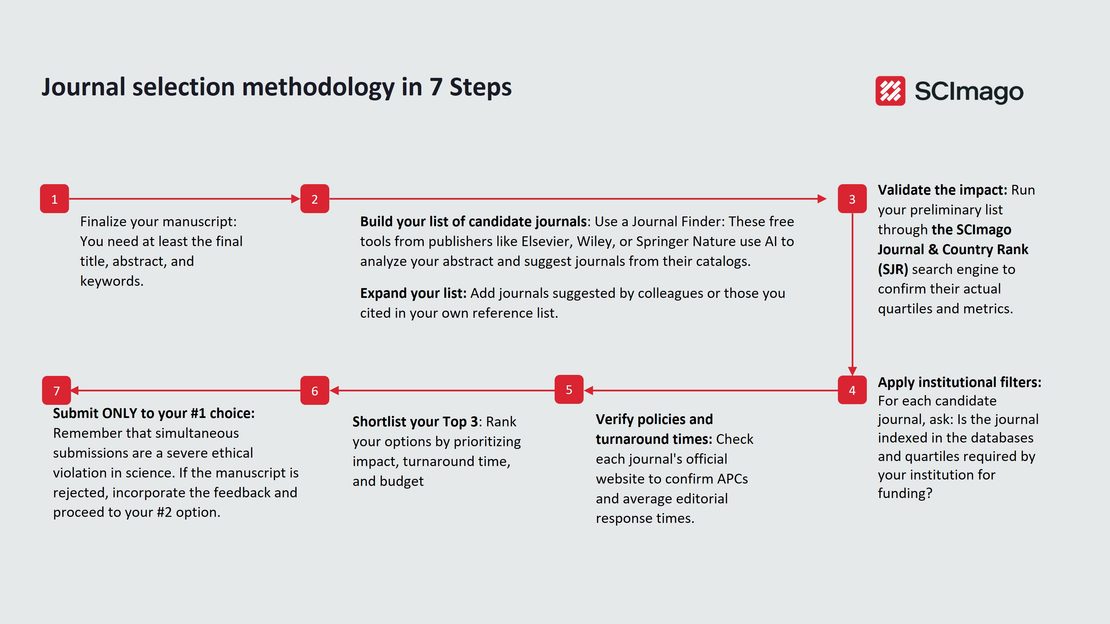
4. Journal selection methodology in 7 steps
To start publishing strategically, follow this workflow:
- Finalize your manuscript: You need at least the final title, abstract, and keywords.
- Build your list of candidate journals:
- Use a journal finder: These free tools from publishers like Elsevier, Wiley, or Springer Nature use AI to analyze your abstract and suggest journals from their catalogs.
- Expand your list: Add journals suggested by colleagues or those you cited in your own reference list.
- Validate the impact: Run your preliminary list through the SCImago Journal & Country Rank (SJR) search engine to confirm their actual quartiles and metrics.
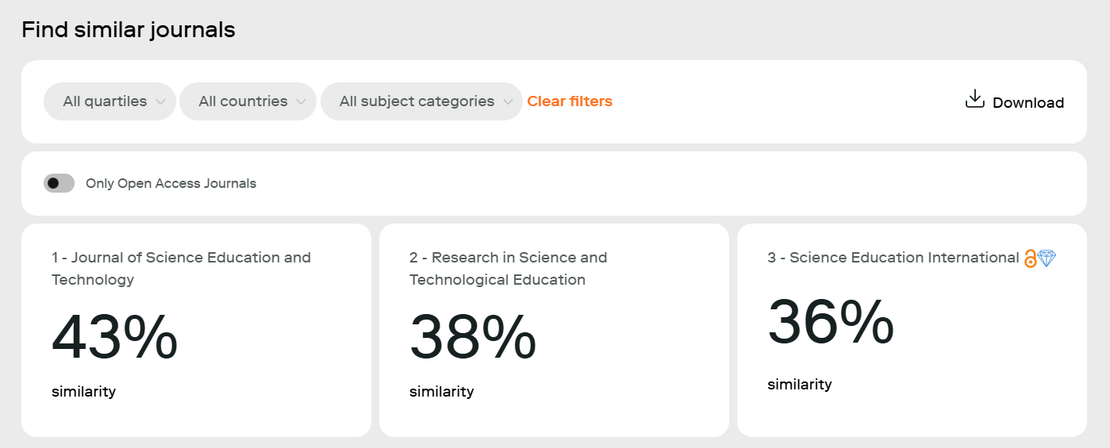
- Identify similar journals: For each candidate journal, use SCImago’s “Similar Journals” tool to identify outlets that have published work sharing the same reference base. This tool is located on each journal’s profile.
- Apply institutional filters: For each candidate journal, ask: Is the journal indexed in the databases and quartiles required by your institution for funding?
- Verify policies and turnaround times: Check each journal’s official website to confirm APCs and average editorial response times.
- Shortlist your Top 3: Rank your options by prioritizing impact, turnaround time, and budget.
- Submit ONLY to your #1 choice: Remember that simultaneous submissions are a severe ethical violation in science. If the manuscript is rejected, incorporate the feedback and proceed to your #2 option.
Scientific publishing is the final bridge between your desk and social transformation. Selecting the right journal is not a mere formality; it is the cornerstone of your scientific visibility.