In today’s academic ecosystem, journal quartiles—created by SCImago and openly available on the SCImago Journal & Country Rank (SJR) portal—have consolidated as the common language of scientific evaluation.
Designing incentive policies, evaluating faculty performance, or structuring applications for international funding requires speaking in terms of “Q1,” “Q2,” “Q3,” and “Q4.” However, making decisions based on these metrics requires moving beyond administrative interpretation to turn them into a strategic governance tool.
What are SCImago quartiles?
In the publishing context, Dr. Félix de Moya, CEO of SCImago, conceived and introduced quartile measurement as a methodological solution to rank and evaluate scientific journals within their respective fields of knowledge.
A quartile is a relative position measure that divides an ordered dataset into four equal parts (25% each). To build this classification, SCImago first calculates the SJR (SCImago Journal Rank) indicator, which measures a journal’s prestige by weighting not only the number of citations received within a specific timeframe but also the value and weight (prestige) of the citing sources.
Subsequently, journals within the same subject category are ranked from highest to lowest according to their SJR and divided into four segments:
| Quartile | Percentile Range | Analysis |
| Q1 | Top 25% | Journals positioned at the peak of prestige and visibility in their field. |
| Q2 | 50th to 75th percentile | Publications with an impact above the sector’s median. |
| Q3 | 25th to 50th percentile | Journals with intermediate visibility in their discipline. |
| Q4 | Bottom 25% | Publications located in the initial citation tier of their category. |
The global landscape
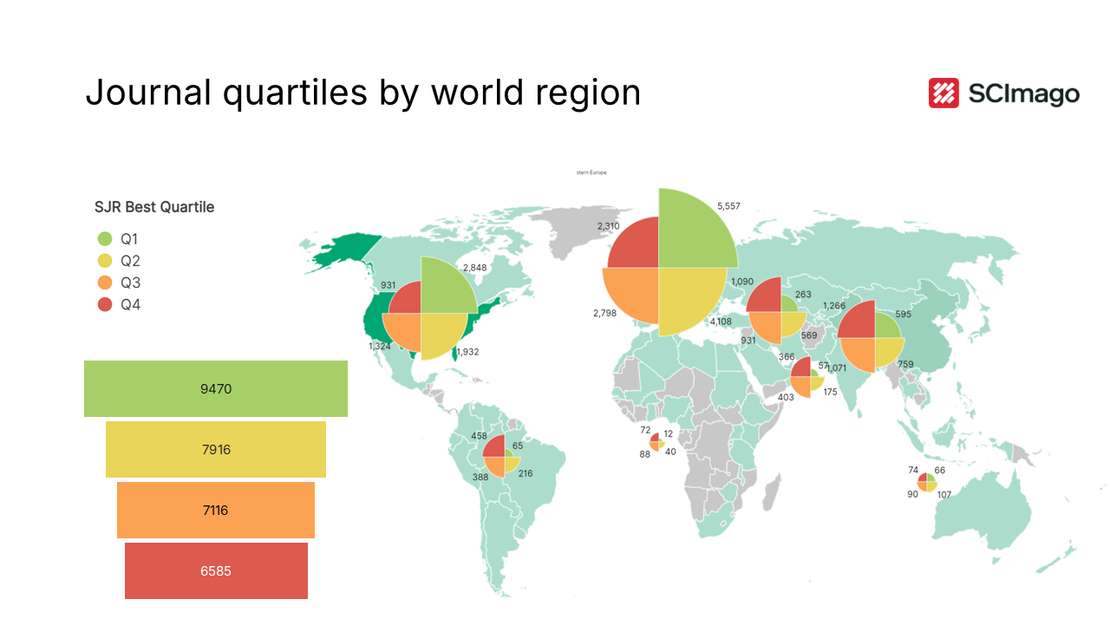
To understand the influence of different regions in scientific publishing, it is essential to observe how journals are geographically distributed according to their highest achieved quartile. This global perspective reveals distinct structural dynamics in science:
Europe and North America concentrate the highest proportion of journals positioned in the Q1 bracket, leading editorial visibility at an international level.
When accounting for the highest quartile of each publication globally, the volume of journals in the Q1 tier (9,470) is the largest in the ecosystem, progressively decreasing towards Q2 (7,916), Q3 (7,116), and Q4 (6,585).
Other regions show distributions where the Q3 and Q4 tiers have a highly representative presence, graphically illustrating the structural challenges and the need to strengthen the positioning of journals in high-impact circuits.
What are they used for?
The core purpose of quartiles is to normalize scientific evaluation across different disciplines, resolving structural citation asymmetries.
Interdisciplinary equity: Fields such as biomedicine or engineering generate drastically higher citation volumes and speeds than pure mathematics or the humanities. The innovation of quartile measurement allows for a fair comparison: a social science researcher publishing in a Q1 journal in their specialty achieves a standard of excellence equivalent to that of an oncologist in a Q1 journal in theirs.
Strategic guidance for decision-making: They serve as a compass for defining institutional publication policies, allocating research resources, and establishing transparent criteria for academic hiring or promotion.
International benchmarking: They allow institutions to evaluate the positioning of their scientific output against global standards without falling into misleading absolute comparisons.
Distribution across 6 knowledge categories
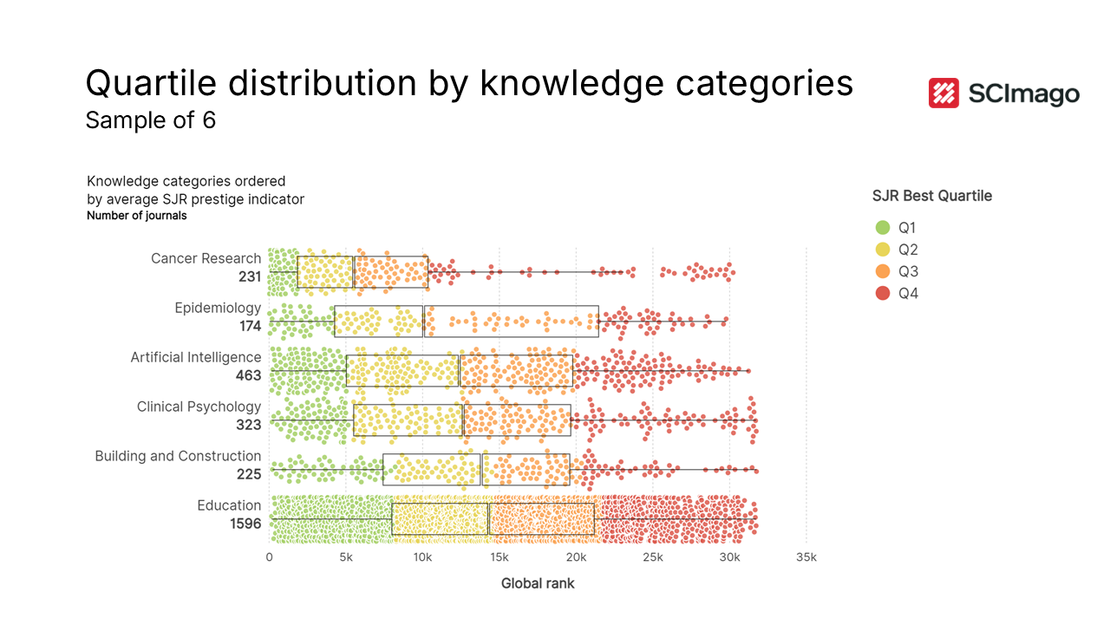
Why do we insist that the quartile normalizes evaluation? Comparing absolute positioning in a sample of six knowledge areas demonstrates why it is a methodological error to compare disciplines directly.
There is a disparate density within editorial ecosystems; while the area of Cancer Research operates in a highly concentrated niche of 231 journals, disciplines like Education harbor a massive and dispersed universe of 1,596 publications.
Health science areas tend to naturally cluster at the top of the absolute global ranking (values closer to 0). Without tier normalization (Q1-Q4), a top journal in Building and Construction or Clinical Psychology could never compete in absolute numbers against an average medical publication.
The wide dispersion of journals in fields like Artificial Intelligence shows that each discipline traces its own natural impact curve throughout the ranking. The quartile acts as the ultimate equalizer to guarantee an equitable evaluation.
Relevant considerations
To prevent decision-makers from using quartiles uncritically and generating reputational vulnerabilities or evaluation biases, university management must consider three critical factors:
- The “Container Effect”: The quartile evaluates the journal’s trajectory, not the individual quality of an article or author. A Q3 journal can publish an exceptional piece of work, while a Q1 journal might house a modest study. The container’s metric must never replace expert judgment of the content.
- Annual dynamism and volatility: SCImago updates quartiles annually. A journal can change quartiles from one year to the next due to the entry of new publications or shifts in the category’s competition. Rigid regulations that fail to account for this dynamism may be placing bets on outdated information.
- Multi-category behavior: SCImago can index a journal in more than one discipline simultaneously, and the journal can present different quartiles in each (for example, being Q1 in Geography and Q3 in Environmental Sciences). Institutions must clearly regulate which criterion they will adopt in the face of these discontinuities.
Current trends demand a shift toward institutional intelligence tools like the SCImago Journal & Country Rank, which enable monitoring the behavior of scientific communication channels. In this same line of optimization, we invite you to consult the 6 Strategies to enhance the scientific visibility of journals to maximize the impact of your output.
Understanding quartiles from their technical origin and normative value allows institutions to use them as the starting point for mature, informed, and excellence-driven scientific governance.