By Gali Halevi, Senior Scientific Advisor
After examining the hidden costs when the system fails in Part 1 and the investments needed to maintain safeguards in Part 2, we close our series on The Economic Cost of Research Integrity by looking at the bigger picture. In this final installment, Gali Halevi explores how moving from individual cases to broader publication patterns—supported by benchmarking tools like SCImago IRIS—helps institutions and publishers treat research integrity as a strategic investment.
Much of the research integrity infrastructure currently used by publishers is designed to examine individual manuscripts or investigate specific concerns, which is necessary because many problems can only be understood through a detailed examination of the underlying article, its data, images, methods, and publication history.
However, when the economic implications of research integrity across an institution or a portfolio of journals are considered, it becomes useful to look beyond individual cases and ask whether broader patterns might help understand where resources are being invested, where problems are repeatedly emerging, and where additional support or oversight may be appropriate.
For example, an institution may wish to examine whether unusual authorship practices, publication patterns, citation behavior, or retraction activity are concentrated in particular areas of its research output, while a publisher may want to understand whether some journals display patterns that differ substantially from those of comparable publications.
These observations cannot indicate whether individual researchers or journals have engaged in misconduct, but they can provide a starting point for asking questions that may not emerge from examining manuscripts one at a time.
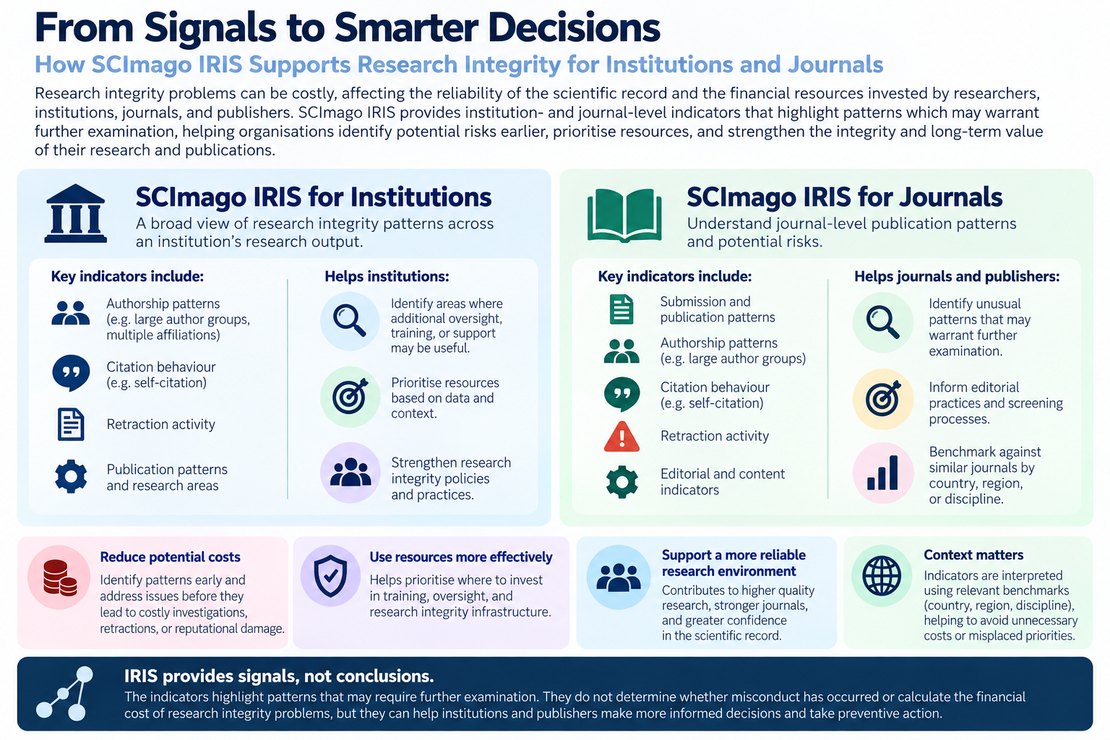
This is where SCImago IRIS for Institutions and SCImago IRIS for Journals can contribute to the discussion, because both platforms approach research integrity from a broader analytical perspective, using publication-related indicators to identify patterns that may warrant further examination rather than attempting to establish misconduct at the level of an individual article.
For institutions, IRIS provides an opportunity to examine research integrity signals across institutional publication activity, potentially helping research managers and integrity professionals identify areas where additional investigation, training, or institutional support might be useful.
For journals and publishers, the journal-level platform offers a similar perspective on publication and editorial patterns, allowing users to consider whether particular indicators deserve closer attention and whether those observations might justify a more detailed examination of editorial practices. The distinction is important because these platforms do not replace the technologies and expert processes used to examine individual manuscripts, nor do they calculate the financial cost of misconduct or provide definitive assessments of the integrity of an institution or journal.
Their potential value lies in helping organizations identify questions that deserve attention, particularly when the volume of published research makes it difficult to understand broader patterns through individual investigations alone.
Why benchmarking matters when resources are limited
One of the central features of SCImago IRIS is its benchmarking approach, which allows users to examine indicators in relation to different comparison groups, including countries, regions, and disciplines.
This is particularly relevant when discussing the economic implications of research integrity because an indicator that appears unusual in one context may be entirely consistent with established research or publishing practices in another, and acting on such observations without considering the appropriate benchmark could lead institutions and publishers to invest resources in investigating patterns that have reasonable disciplinary or organizational explanations.
A journal with a relatively high level of self-citation, for example, may initially appear to require closer examination, but the interpretation may change when the journal is compared with others operating in a highly specialized discipline where the relevant literature is concentrated in a relatively small number of publications. In a similar way, an institution with a high proportion of articles involving large author teams may appear unusual when compared with institutions in other research areas, even though large-scale collaboration is a normal feature of the disciplines in which it operates. Retractions provide another example of why context matters, since a higher number of retractions may reflect serious problems in published research, but it may also be associated with greater publication volume, more active editorial scrutiny, or stronger mechanisms for identifying and correcting errors.
Interpreting retraction activity without considering these differences could lead to conclusions that are not supported by the evidence, and potentially to decisions that direct resources toward the wrong problems. In this sense, benchmarking is not simply a technical feature that changes how an indicator is displayed, but an important part of determining what the indicator may mean and whether it provides a reasonable basis for further inquiry.
An institution or publisher that can distinguish between an unusual pattern and one that is relatively common among comparable organizations may be better positioned to decide where more detailed examination is justified, although those decisions will still require additional evidence, professional judgment, and an understanding of the local circumstances.
This does not mean that IRIS can determine where research integrity budgets should be allocated or demonstrate that using the platform will reduce the financial costs of misconduct, since establishing such outcomes would require separate evaluation. Rather, the platforms offer a way to bring broader evidence into discussions about research integrity priorities, particularly where institutions and publishers need to make decisions about training, editorial oversight, monitoring, and investigative capacity with limited resources.
Understanding research integrity as an investment
When research integrity is examined through its economic implications, the discussion becomes more complicated than simply comparing the cost of prevention with the cost of retractions, because the consequences of unreliable research are not always immediate, the costs are often distributed among organizations that do not share the same budgets, and some of the most important benefits of research integrity investments may be difficult to measure.
A publisher may bear the costs of editorial screening and post-publication investigations, while a university bears the costs of research infrastructure, salaries, and institutional oversight, and a funding organization may have financed the original project without being directly involved in either the publication process or the eventual correction of the article.
When a serious integrity problem occurs, each organization may experience different consequences, even though the underlying failure affects the same scientific record. There is also a reputational dimension that can have longer-term economic consequences, particularly when repeated integrity concerns affect confidence in a journal, publisher, research institution, or body of scientific work.
Although reputational damage is difficult to quantify and should not be assumed to follow every retraction, it may influence the willingness of researchers to submit their work, the confidence of institutional partners, and the decisions of organizations that fund or support research.
At the same time, care should be taken not to frame retractions themselves as evidence that research integrity systems have failed, because identifying problems and correcting the published record are essential parts of responsible scholarly communication.
A system that investigates concerns and issues appropriate corrections may incur visible costs precisely because it is functioning as intended, while a system that rarely reports problems may not necessarily be more reliable or less expensive in the long term.
Therefore, the economic case for research integrity is not about eliminating every possible risk or suggesting that additional technologies and oversight will automatically produce financial savings, but about recognizing that the reliability of scientific research depends on investments made throughout the research and publishing process, and that decisions to reduce those investments should take account of the potential consequences for other participants in the system.
SCImago IRIS for Institutions and IRIS for Journals fit into this discussion by providing an additional perspective on the patterns that institutions and publishers may wish to examine, while their benchmarking approach serves as a reminder that interpreting those patterns requires an understanding of the research and publishing environments in which they occur.
Used alongside manuscript-level screening, editorial expertise, institutional oversight, and appropriate investigative procedures, these platforms can help organizations move beyond responding only to individual incidents and begin asking more informed questions about where attention and resources may be needed.
As the volume of scientific publishing continues to increase and AI becomes more deeply integrated into research and publication workflows, greater attention needs to be paid to the economic implications of the decisions made about research integrity, including what is chosen to be monitored, which safeguards are maintained, and how the effectiveness of those investments is evaluated.
The cost of maintaining research integrity is visible in the people, technologies, and processes that support it, while the cost of failing to maintain it may only become apparent much later, after resources have been committed, unreliable findings have circulated, and the work required to correct the scientific record has become considerably more complicated.