Integrity Risk Indicators from SCImago (IRIS) is a newly launched open platform that brings together nine indicators to provide a comprehensive assessment of institutional research integrity risk.
Each indicator of IRIS focuses on a critical aspect of research publication practices, providing context for understanding institutional publication behaviours and identifying potential areas of concern.
IRIS is not designed as a punitive system. Rather, it provides institutions with an opportunity to examine their publication practices, identify potentially problematic behaviours, and better understand risks that could affect their reputation, research and development activities, funding opportunities, and future collaborations.
SCImago IRIS is functions as an evolving system. As new risks and problematic behaviours emerge in scholarly communication, new indicators can be identified, developed, and incorporated into the platform.
This is particularly important in today’s rapidly changing AI landscape, where an increasing number of articles, datasets, images, and other research outputs are being created or assisted by artificial intelligence. As these technologies evolve, so too do the potential risks to research integrity, creating a need for ongoing attention and action.
Therefore, the tool is not a fixed set of indicators. Rather, it is a growing framework that can evolve in response to current and future developments in research and scholarly publishing.
How does IRIS work?
IRIS draws on data from the latest edition of the SCImago Institutions Rankings (SIR) and provides integrity risk indicators for higher education institutions included in the ranking.
Through its interactive platform, users can explore each institution’s results across individual indicators and compare patterns both nationally and globally. Because the indicators measure different dimensions and use different scales, IRIS applies Z-score normalization to create a common basis for comparison, with zero representing the global average.
- Positive scores indicate higher-than-average exposure to potential integrity risks
- Negative scores indicate lower exposure.
Rather than ranking institutions competitively, IRIS focuses on identifying significant deviations and unusual patterns that may signal structural vulnerabilities, functioning as an early-warning tool for areas that may warrant closer examination.
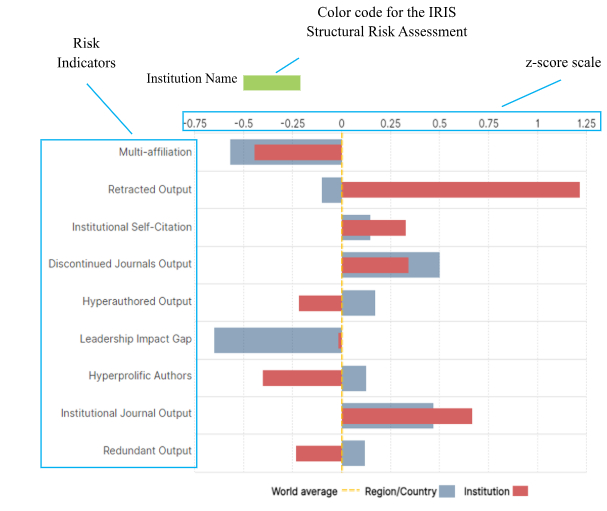
The IRIS indicators
- Rate of Multiple Affiliations- This indicator measures the proportion of an institution’s research output in which at least one author lists multiple institutional affiliations. While often legitimate, unusually high rates may signal affiliation shopping or practices that artificially increase institutional credit, warranting further review.
- Rate of retracted output –This indicator measures the share of research output that journals have formally retracted. Because retractions may result from either honest errors or serious misconduct, users should treat the indicator as a prompt for qualitative investigation rather than direct evidence of misconduct.
- Rate of institutional self-citation – This metric measures the proportion of an institution’s citations that originate from its own authors. While some self-citation is natural, unusually high levels may suggest scientific insularity or attempts to inflate impact, although analysts must consider the specific disciplinary and institutional context.
- Rate of output in discontinued journals –This indicator measures the share of an institution’s research output published in journals subsequently removed from major bibliographic databases due to quality or ethical concerns. High rates may signal vulnerabilities in publication due diligence and a need for stronger support in identifying reliable publishing venues.
- Rate of Hyper-Authored output – This indicator measures the proportion of an institution’s output featuring exceptionally large author teams relative to the relevant discipline and publication year. While large collaborations are legitimate in some fields, unusual patterns elsewhere may warrant review of authorship practices and individual contributions.
- Gap between the impact of total output and the impact of output with a corresponding author from the institution – This indicator compares the impact of an institution’s overall research output with the impact of publications in which it holds a leading authorship position. A significant gap may indicate that high research impact relies heavily on external collaborators, highlighting a potential need to strengthen independent research capacity.
- Rate of Hyperprolific Authors –This indicator measures the proportion of an institution’s research output associated with authors producing more than 25 works per year. While high productivity can be legitimate in some disciplines, extreme patterns may warrant examination of whether output incentives are affecting the depth and transparency of individual contributions.
- Rate of output in institutional journals –This indicator measures the proportion of an institution’s research output published in journals owned or managed by the institution itself. Although institutional journals can play an important role, unusually high rates may raise questions about editorial independence, peer-review objectivity, and excessive reliance on internal publication channels.
- Rate of redundant output – This indicator identifies potentially redundant publications by measuring unusually high bibliographic overlap between works by the same authors published in the same year. While overlap can reflect legitimate research continuity, consistently high rates may signal excessive fragmentation of research into multiple minimal publishable units and warrant further review.
The IRIS system is open
Explore the platform, examine the indicators, and see what the data reveals about institutional research integrity risk.
Try it for yourself https://www.scimagoiris.com/