In the scientific ecosystem, top-tier science that fails to cross the frontier of public visibility is condemned to strategic irrelevance. While institutions focus on generating and consolidating bibliometric indicators, another challenge is emerging on a new frontier: the ability to inhabit and master the global digital communication ecosystem.
Simply publishing is no longer enough; the current challenge for academic leaders is to communicate their major scientific contributions, those that grant them high reputation, within a communication network that is diverse, segmented, and often displays little inherent interest in scientific development.
The dissociation between science and visibility
For years, outreach management has operated under the premise that exceptional science guarantees public visibility organically. Data presented by Dr. Félix de Moya, CEO of SCImago, at the CRECS 2026 conference, prove that this has changed. A structural dissociation exists where institutions with massive scientific production suffer from critical visibility asymmetries, particularly within the Anglosphere.
Traditional metrics are no longer sufficient to understand why certain research transforms industry while others remain in repositories. The problem is not the content; it is the lack of a tactical cartography that connects science with society.
SCImago Atlas provides elements to understand: Why does some science remain in the shadows?
Data from the SCImago Atlas, the new data visualization tool for institutions and media outlets worldwide presented at CRECS 2026, demonstrate an alarming structural dissociation. Through this technology, we have identified a set of barriers that traditional metrics fail to address:
- Language as a frontier: Linguistic proximity determines the media radar more than geographic location. High-prestige outlets (Nature, NYT) act as major attractors for international mentions.
- Fragmentation: Highly productive institutions in Asia and Latin America remain isolated in national “echo bubbles,” failing to achieve alignment between what they publish and what digital media disseminates.
- Thematic bias: The global news cycle almost exclusively favors biomedicine and climate, leaving critical areas of science without media traction.
SCImago Atlas connects the prestige of institutions present in the SCImagoIR with the reputation of the media outlets included in SCImagoMedia. This powerful combination transforms it into a tactical and operational tool for research institutions, particularly universities.
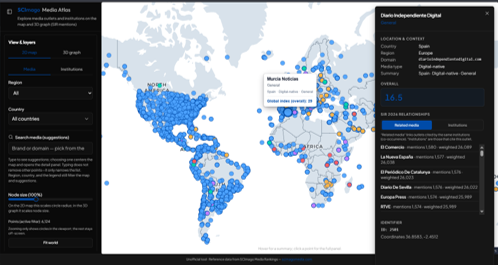
This tool provides scientific communication managers with unprecedented applicability:
- Transitioning from reactive reputation management to a proactive governance of scientific credibility and prestige.
- Identifying the media hubs where institutional science can and must have a presence.
- Closing the gap between academic production and real social impact.
Decision-making through the SCImago Atlas is strengthened by objective data that mitigate the subjectivity of traditional surveys:
- Media Visibility Index (MVI): A normalized metric that evaluates not only the volume of mentions but also the prestige of the media outlet and its geographic reach.
- Layered penetration model: An audit of institutional positioning ranging from national media (C1) and regional international media (C2) to major global nodes (C3).
Visibility is not a media accident; it is the result of a well-executed data strategy. SCImago Atlas stands as the indispensable ally for institutions to not only produce knowledge but to master its communication and global impact. The future of university governance must include a precise cartography of its visibility and reputation.