How can institutions protect their reputation while enhancing their impact?
Higher education institutions face a highly competitive environment today. They must simultaneously respond to their own internal challenges, the regulatory demands of ministries or accreditation agencies, and global competition.
To successfully navigate this complex scenario, it is imperative to design and implement well-articulated research policies. These strategic guidelines allow for the translation of broad university aspirations into concrete goals. In this way, strategic and institutional accreditation plans are transformed into a roadmap, with measurable and verifiable results in the short or medium term.
The shift towards open science
Contemporary scientific development demands that universities transition decisively towards the Open Science model. This approach encompasses a set of ethical practices applied throughout the entire lifecycle of research projects.
By making the processing of scientific data transparent, the levels of integrity, reproducibility, and replicability of science are substantially raised.
The greatest analytical benefit of this paradigm lies in the credibility it grants to the research activity deployed by the institution. From this perspective, knowledge ceases to be an isolated asset to become a public good, accessible through open-access collaborative networks.
To consolidate this transition and promote responsible conduct in research, university management must ensure four operational pillars:
- Institutional research policies must be clear, aligned, and relevant.
- Strengthening a shared ethical culture across the entire academic community.
- Deployment of a strategic continuous training plan for teaching staff.
- Opening technological infrastructure and repositories oriented towards open science objects.
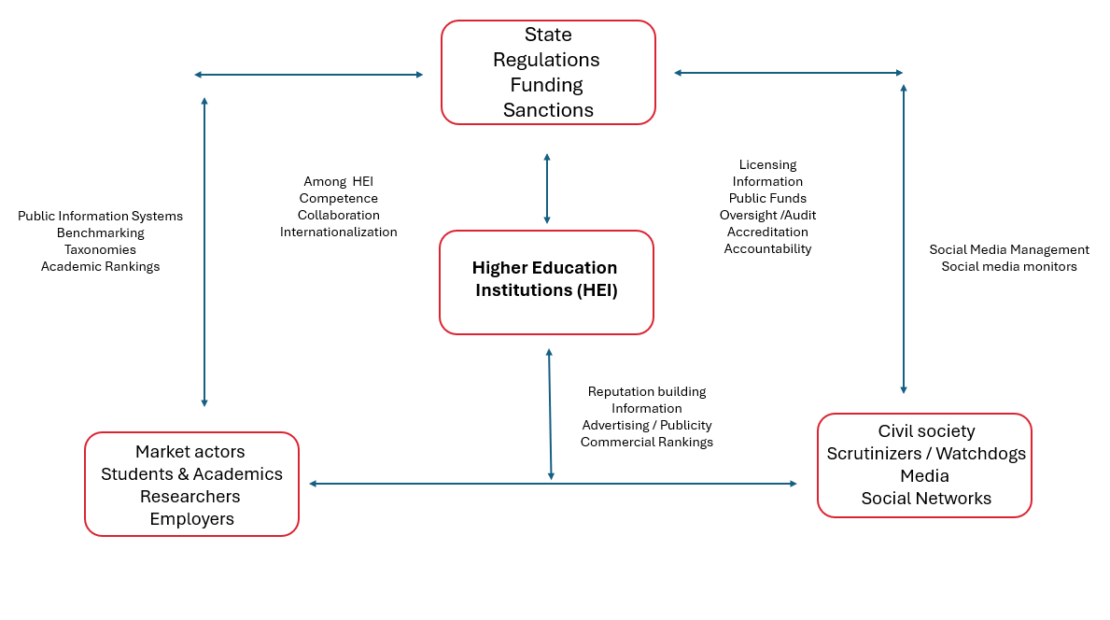
*Fig.1 Clark-Engwall-Soto Model for Quality Assurance in HEIs. Adapted from Clark (1983) and Engwall (2020).
Institutional consolidation and capacity monitoring
Mitigating scientific integrity risks and strengthening internal capacities requires a highly integrated regulatory ecosystem. It is not enough to decree demanding goals based on institutional reality; it is essential to structure real incentives and support for scientific production (Fig.1).
Research management must focus on critical actions to transform guidelines into tangible institutional advantages, And in the monitoring of risk indicators, such as those offered by the SCImago IRIS platform.
Strategic priorities include:
- Accurately measuring inputs, processes, and the scientific, technological, and public policy impact generated.
- Designing highly attractive economic incentives and academic promotion programs.
- Constantly training academics to expand the base of active researchers.
- Developing information services (such as open-access institutional repositories, CRIS management systems, or proprietary journal portals) that are connected and indexed in large global databases.
- Implementing institutional tracking systems to safeguard reputation against any eventuality.
Cultivating Integrity
The positioning of a university depends directly on the robustness and efficiency of its research policies. Transversally adopting the Open Science model reduces reputational threats and boosts institutional excellence.
However, sustaining this culture of integrity requires constantly measuring and monitoring compliance. Utilizing advanced monitoring tools, such as the SCImago IRIS platform, constitutes the key decision for preventing situations that could damage institutional reputation.
How is your institution adapting its research policies to embrace Open Science?